Get Access to free PDF

Unlock the Power of Prompt Engineering 101
Master the art of prompt engineering and supercharge your AI projects with our comprehensive guide. Learn the secrets behind crafting effective prompts.


Master the art of prompt engineering and supercharge your AI projects with our comprehensive guide. Learn the secrets behind crafting effective prompts.

The most useful AI prompt templates for technical writing cover five tasks: repurposing existing content without hallucinations, drafting new articles from screenshots, keeping tone and terminology consistent with reusable snippets, updating help articles after UI changes, and converting legacy content into structured DITA. Promptitude.io provides ready-to-use versions of each.
Key points:
Technical writing has evolved. It is no longer just about producing clear documentation — it is about enabling documentation automation, supporting AI systems, and maintaining consistent product knowledge across teams.
As shown by preliminary results of the 2026 State of AI in Technical Writing survey, even among teams already experimenting with AI, many are still testing, learning, and negotiating where AI fits safely into their workflows.
This signals adoption, but not maturity. Many teams use AI to speed up writing. Few use it with structured prompts designed for technical documentation workflows. That’s where prompt templates become essential.
.png)
AI-generated documentation is only as reliable as the context behind it. In technical writing, context is not abstract — it is operational. It includes product architecture, version history, release scope, target audiences, compliance constraints, terminology standards, and the countless product decisions that shape how systems actually work.
Most documentation teams are not struggling because they can’t write fast enough. They are struggling because context is scattered and operational alignment is weak. Product updates live in roadmaps, technical decisions happen in engineering threads, release details sit in version control systems, and customer issues accumulate in support platforms. Writers are often expected to reconstruct this fragmented knowledge after the fact.
At the same time, generative AI has moved from experimentation to production. Organizations are operationalizing AI across core business functions, and documentation is emerging as one of the most promising areas for measurable impact. But AI will only improve productivity if it addresses the real issue: connecting product context, knowledge workflows, and documentation systems in a way that reduces friction instead of adding another disconnected tool.
If writers lack early visibility into product decisions, AI cannot reconstruct that missing context later. If product knowledge is scattered, AI will amplify the inconsistency. The shift redefining modern technical writing is therefore not about writing speed — it’s about building structured context into documentation workflows so AI can scale clarity, accuracy, and alignment with every release.
Teams rely heavily on general-purpose AI tools, but these tools do not automatically understand:
Without contextual grounding, AI cannot support true documentation automation. Prompt templates solve part of this by structuring requests. But scalable AI in technical writing requires something more: systematic context injection.
.png)
To scale AI in technical writing, context cannot remain manual or scattered. It needs to be structured, reusable, and embedded directly into documentation workflows.
Promptitude acts as a context orchestration layer for technical writing teams. Instead of relying on one-off prompts, it allows organizations to operationalize AI with real product knowledge at its core.
Promptitude connects your existing documentation sources — including PDFs, Markdown files, DITA repositories, and knowledge bases — so AI writes with actual product context, not generic assumptions. Your documentation becomes the foundation the AI reasons from.
Our platform transforms strong prompts into shared, reusable AI tools for tasks like release notes, topic drafts, summaries, and API documentation. Instead of reinventing prompts, teams standardize them.
Consistency is critical in technical documentation. Promptitude enforces tone guidelines, glossary terms, and disallowed language across everything the AI generates. Instead of correcting output after the fact, standards are embedded directly into the generation process.
The result is simple: AI doesn’t just write faster — it writes aligned, consistent, and grounded in your product reality.
Here are five practical AI prompts from Promptitude.io that show how structured context can make your technical writing faster, more consistent, and more accurate:
This prompt helps you take existing documentation and adapt it for new channels or formats—like turning a help article into a how-to guide or tutorial. Promptitude ensures the AI only uses relevant, secure content, preventing errors or hallucinations.
👉 Try this prompt on Promptitude to streamline content reuse while maintaining accuracy.
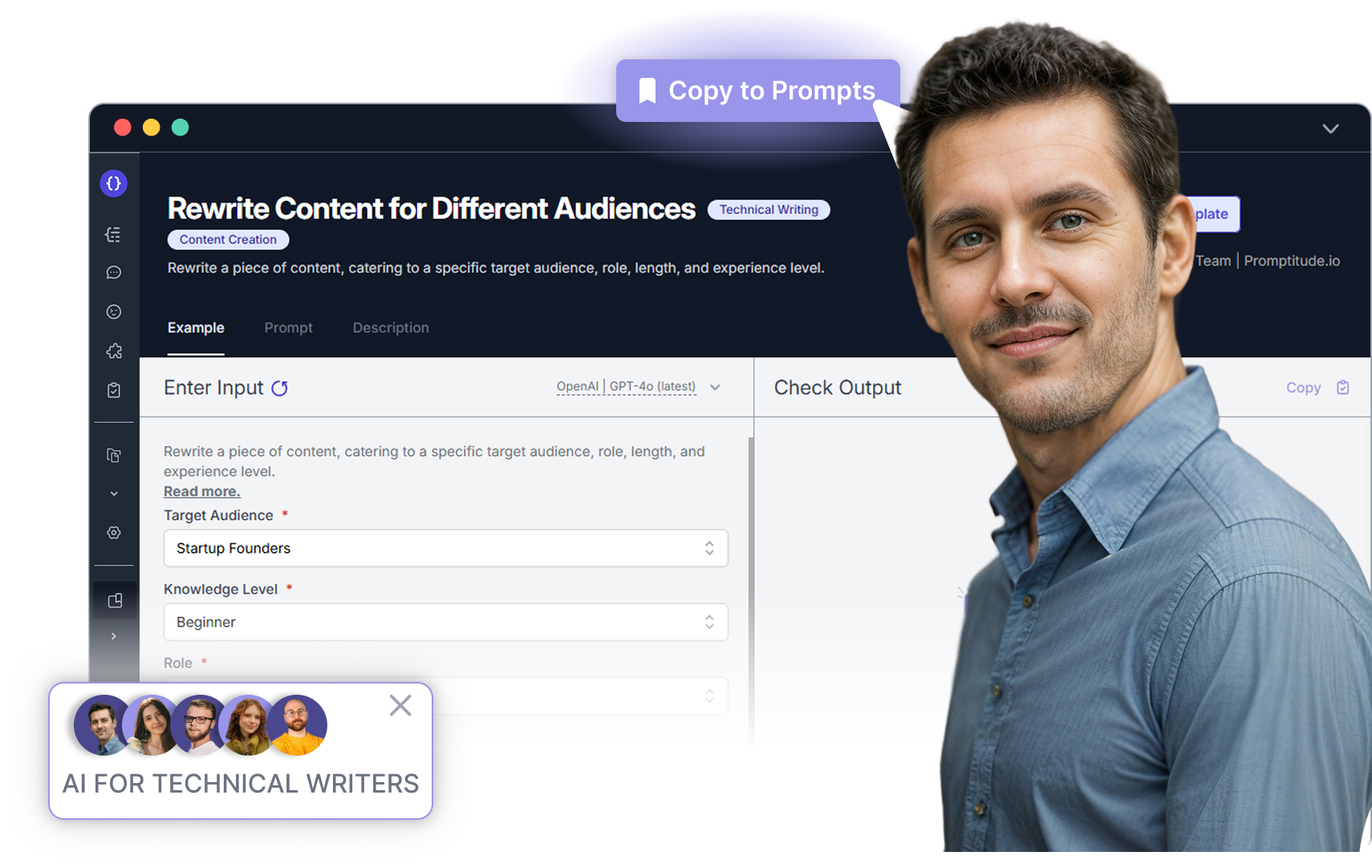
Provide minimal text and screenshots, and the AI leverages multi-modal understanding to analyze images (beyond simple OCR) and generate an initial draft in minutes.
This prompt saves time and helps you create clear, visually informed documentation quickly.
👉 Try this prompt on Promptitude to turn screenshots into structured drafts.
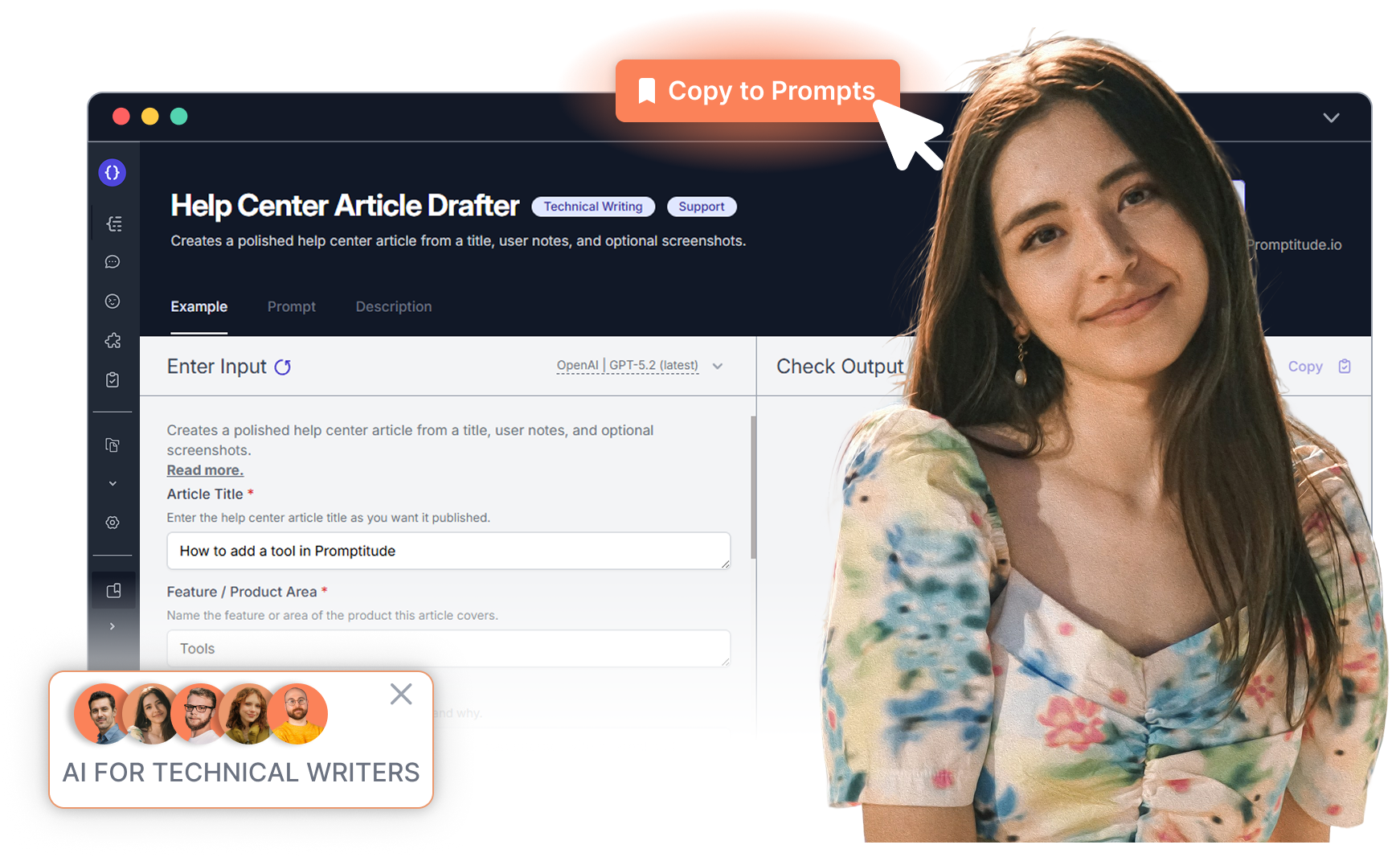
Store style guides, tone instructions, and glossary terms as reusable snippets. Add them to any prompt so AI output remains consistent across multiple documents. Updates to snippets propagate automatically to all prompts.
This ensures every article, guide, or release note matches your brand and technical standards.
👉 Try this prompt on Promptitude to maintain style consistency effortlessly.

Provide an article and new screenshots, and the AI adapts content based on UI updates. This reduces the manual effort required to keep documentation aligned with product changes.
It’s perfect for software releases, dashboards, or any interface that evolves frequently.
👉 Try this prompt on Promptitude to quickly refresh your help documentation.
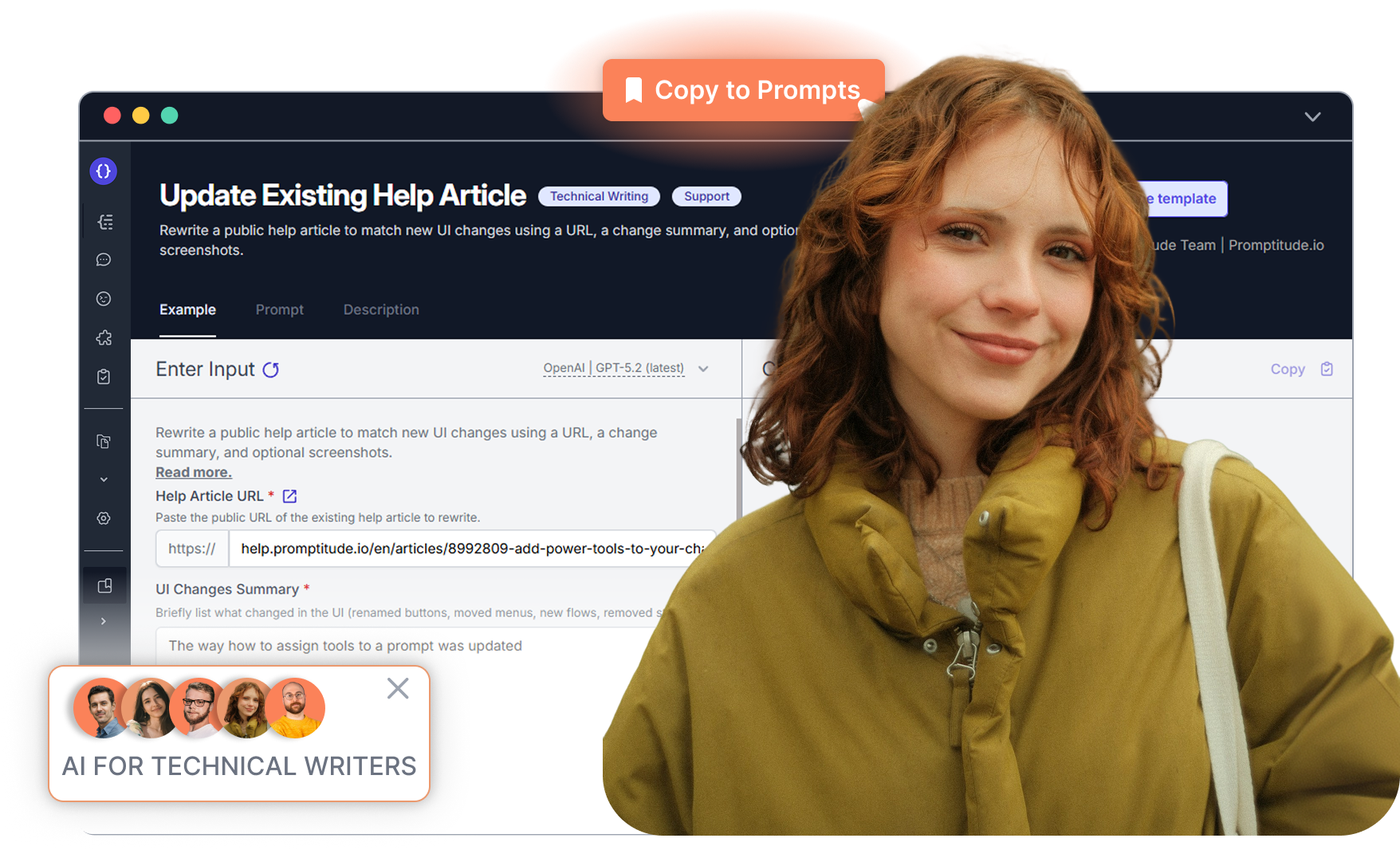
Extract DITA elements from legacy articles with a prompt that guides the AI to produce a table of concepts and references. This acts like a personal assistant, helping writers convert legacy documentation into structured, reusable content.
It’s ideal for modernizing large documentation libraries without losing critical information.
👉 Try this prompt on Promptitude to convert legacy content into structured, actionable DITA.
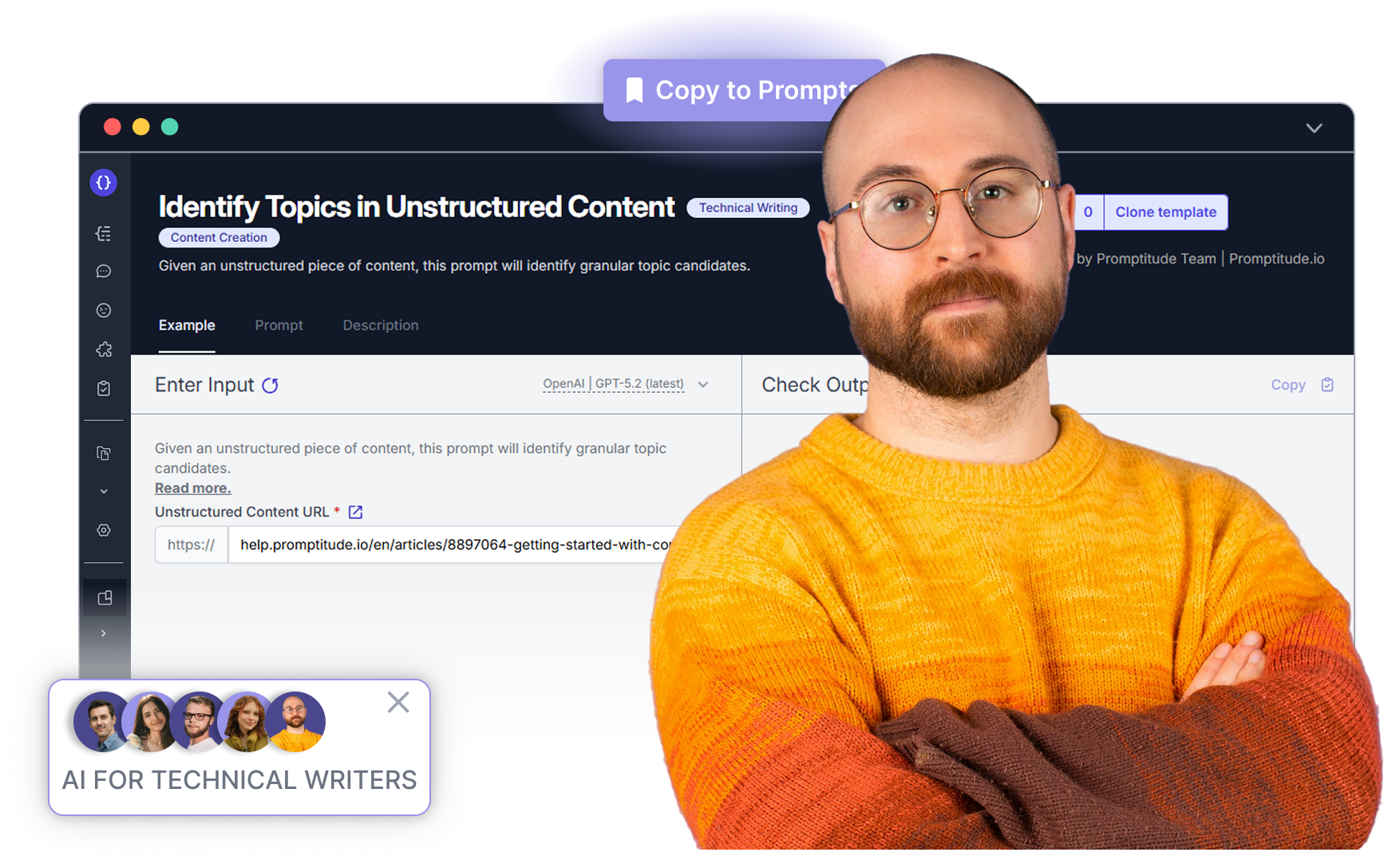
The future of technical writing is not just about faster content creation — it’s about combining creativity, structured context, and intelligent prompt engineering to produce clear, engaging, and reliable documentation. Technical writing prompts help teams overcome blocks, maintain consistency, and deliver content that resonates with diverse audiences.
Platforms like Promptitude.io take this further by turning prompts into reusable, AI-powered tools. By connecting your product knowledge, enforcing tone and terminology, and standardizing workflows, Promptitude ensures that AI-generated content is not only faster but also accurate, aligned, and ready for production. Whether you’re creating software specs, SOPs, release notes, or reports, your team can work smarter, save time, and collaborate more effectively.
One thing stands out: the real power comes when AI is paired with context. AI accelerates writing, but context-driven systems like Promptitude transform technical documentation into a scalable, reliable, and creative part of your product infrastructure.
Ready to elevate your technical writing? Explore Promptitude.io and see how smart prompts and structured context can help your team create better content faster and with less effort.
What is an AI prompt template for technical writing?
An AI prompt template is a reusable, structured prompt that generates a specific type of documentation — release notes, help articles, API docs — consistently, using the same context, tone rules, and format every time it runs.
How do AI prompt templates prevent hallucinations in documentation?
Templates reduce hallucinations by restricting the AI's source material to approved content, such as existing docs or a content storage library, rather than letting it draw on general knowledge. Promptitude applies this restriction automatically when a prompt is linked to stored content.
Can AI prompts convert legacy content into DITA format?
Yes. A prompt can be structured to extract DITA elements — concepts, tasks, and references — from unstructured legacy articles and output them as an organized table, which simplifies migrating older documentation into a structured authoring system.
Do AI prompt templates work with screenshots and images?
Some AI models accept multi-modal input, so a prompt can take a screenshot alongside text instructions. This lets a writer generate an initial help-article draft from a UI screenshot and a short description instead of starting from a blank page.
How do reusable snippets keep AI-generated documentation consistent?
Reusable snippets store style guides, tone instructions, and glossary terms in one place. Adding a snippet to a prompt applies those rules automatically, and updating the snippet propagates the change across every prompt that uses it.


Easily incorporate advanced generative AI into your team, product, and workflows with Promptitude's plug-and-play solutions. Enhance efficiency and innovation effortlessly.
Sign Up Free & Discover NowExperience the perfect AI solution for all businesses. Elevate your operations with effortless prompt management, testing, and deployment. Streamline your processes, save time, and boost efficiency.
Unlock AI Efficiency: 50k Free Tokens