Zugriff auf kostenloses PDF erhalten

Entfesseln Sie die Kraft von Prompt Engineering 101
Master the art of prompt engineering and supercharge your AI projects with our comprehensive guide. Learn the secrets behind crafting effective prompts.


Master the art of prompt engineering and supercharge your AI projects with our comprehensive guide. Learn the secrets behind crafting effective prompts.


Justyna Hietala is Senior Design Engineer specializing in technical documentation, with over 10 years of experience across various areas of documentation. She has previously worked on operating and maintenance instructions for a range of machines in the metal industry and now works in the metrology and calibration industry.
She has been responsible for migration to DITA, designing the information architecture, and developing a publishing environment based on DITA-OT, including customized plugins using XSLT and XSL-FO. She works with a Docs-as-Code approach to ensure efficient, maintainable, and scalable documentation workflows.
Currently, she supports product releases by working with DITA, including content creation, manual updates, translation management, and maintaining the publishing environment.
Justyna has also presented at international documentation events, including DITA Europe, DITA-OT Day, and TC World. Currently exploring AI in technical writing—curious, with a critical eye, and learning one prompt at a time.
The world out there is changing rapidly. As a regular millennial, I remember the early days of the Internet: its first steps, the first webpages with eye-hurting layouts and colors made in Notepad, and the time when we shifted from using a set of 27 books of the Encyclopedia to asking Google things. Oh, the good times, when the Internet was filled mostly with carefully selected information. It felt like such a huge step, the possibility to ask the computer something and actually get a reasonable answer (if it existed somewhere already).
25+ years later, we can ask the same computer virtually anything, and it can generate an answer for us in seconds, sometimes even being creative about it! We can talk with a computer as if there were an actual human being on the other side answering us. As the digital world evolves, technical writers are finding new and innovative ways to evolve along with it. We might be a bit worried that Artificial Intelligence could take our work from us and maybe even do it better. However, It is still quite new and unfamiliar. After all, AI has been with us, regular folks, for just a bit more than three years, so we naturally keep our eyes and ears open for any news in this area.
A few months ago, I participated in the DITA Europe event, and it was not a surprise to me that the majority of sessions were AI-related. “AI will fully automate your tasks”, “AI will boost the localization process at your company”, “AI will generate text for you and even check it against terminology and style guides”. All very important, and it would be very nice to have, but let’s face it: all of this would require time and resources for research and implementation. And if you are a small team, or a one-person team like me, you simply do not have that time.
At the same time, you desperately need something to help with the enormous workload, because when you carry a heavy load, any possible time saving is crucial. But with two tracks full of AI promises, how do you distinguish which ones could actually guide you into using AI effectively in your work?
I am not a frequent AI user, nor a technical expert. AI is still somewhat foreign to me. Sure, I use it for explanations of terms I am not familiar with. I may even use it to check the correctness of my content. But even with infrequent use, I have noticed that AI has a slight tendency to change its mind. For example, yesterday it suggested adding a comma to a sentence in my manual, justifying it with proper grammar. Today, when I did the final check, it suggested removing the comma for grammatical correctness. So which way is it, really?
I am one of those people whose trust is not easily earned, and none of AI models has succeeded so far. So even with a long list of promised benefits, it is a high threshold for me to start using an AI tool and incorporate it into my daily work. After all, how much can I trust AI?
Wait… Virtual Humans? Is This for Real, Mr. Promptitude?
One presentation at DITA Europe sparked my interest: Powering AI and Virtual Humans with DITA Content. For me, a simple technical writer, it was a bit scary to hear how close we are to using virtual agents, fed with our carefully crafted structured content, as the sole support for our users. What will happen to our precious manuals?!
Aside from being almost in utter shock after hearing about the latest AI developments, I wrote down one word in my notes that was unfamiliar but interesting: Promptitude.
After the presentation, I stopped one of the presenters, Dominik Wever (the CEO of Promptitude), and quite bluntly asked, “What is this Promptitude you were talking about? Tell me more”. I remember thinking that his answer sounded very smart and technical, perhaps a bit over my head, but I kept listening. He talked about prompt engineering, but I didn’t understand much.
I will be honest with you, after hearing about Promptitude, I was not convinced, and I didn’t see a clear use case for me, a single technical writer who is mostly trying to survive the daily struggles of an understaffed team. Sure, every new tool supposedly brings time savings, efficiency, and other overly promised virtues, but you are often required to put in a huge effort first just to learn it before you can take it into use. You often have to wait a long time to see visible benefits.
The reality is that at this moment, with all the upcoming releases and a very long list of backlog tasks, this feels like something that will eat up my time without actually making my work easier.
Unfortunately for me, curiosity won. I decided to give it a go and test Promptitude with the judgmental eye of a self-proclaimed, non-technical AI skeptic.
The Promptitude platform will have to impress me with more than Dominik’s charisma and persuasive storytelling.
Oh, I almost forgot about a fun twist. Since this is AI-related, I will be consulting AI along my journey on things I am not sure about, starting with Promptitude as a company.
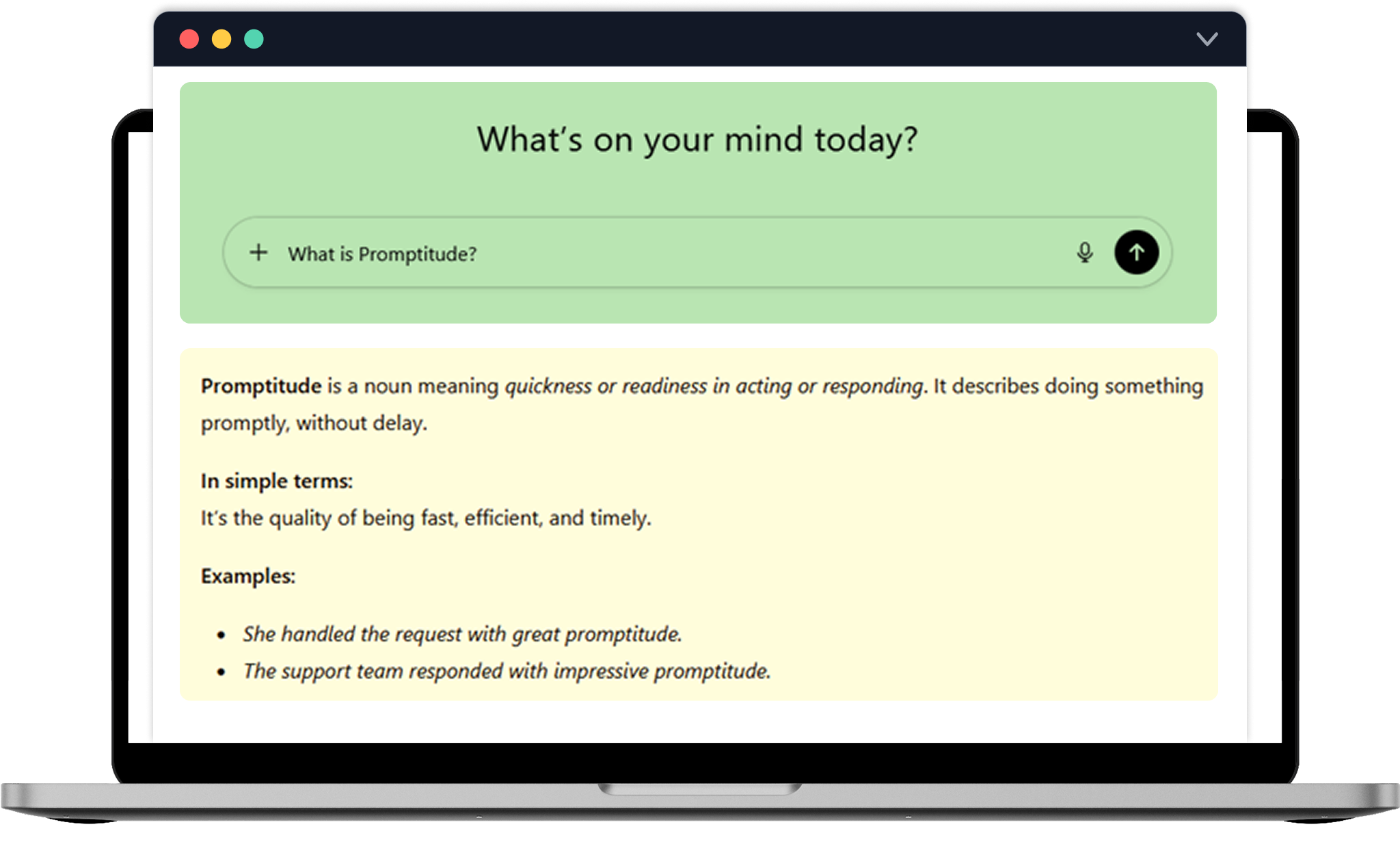
Obviously, this was not a well-crafted prompt. Now I can hear Dominik’s words ringing in my head: “A well- crafted prompt is really important”. So let’s stop for a moment and check what an AI prompt actually is at https://www.promptitude.io/glossary/prompt.
“A prompt is a piece of text that serves as input for an AI language model. It can be a question, statement, or set of instructions that tells the AI what kind of output you're looking for.”
Great, but what does that mean in practice? I’ll try to be more specific.
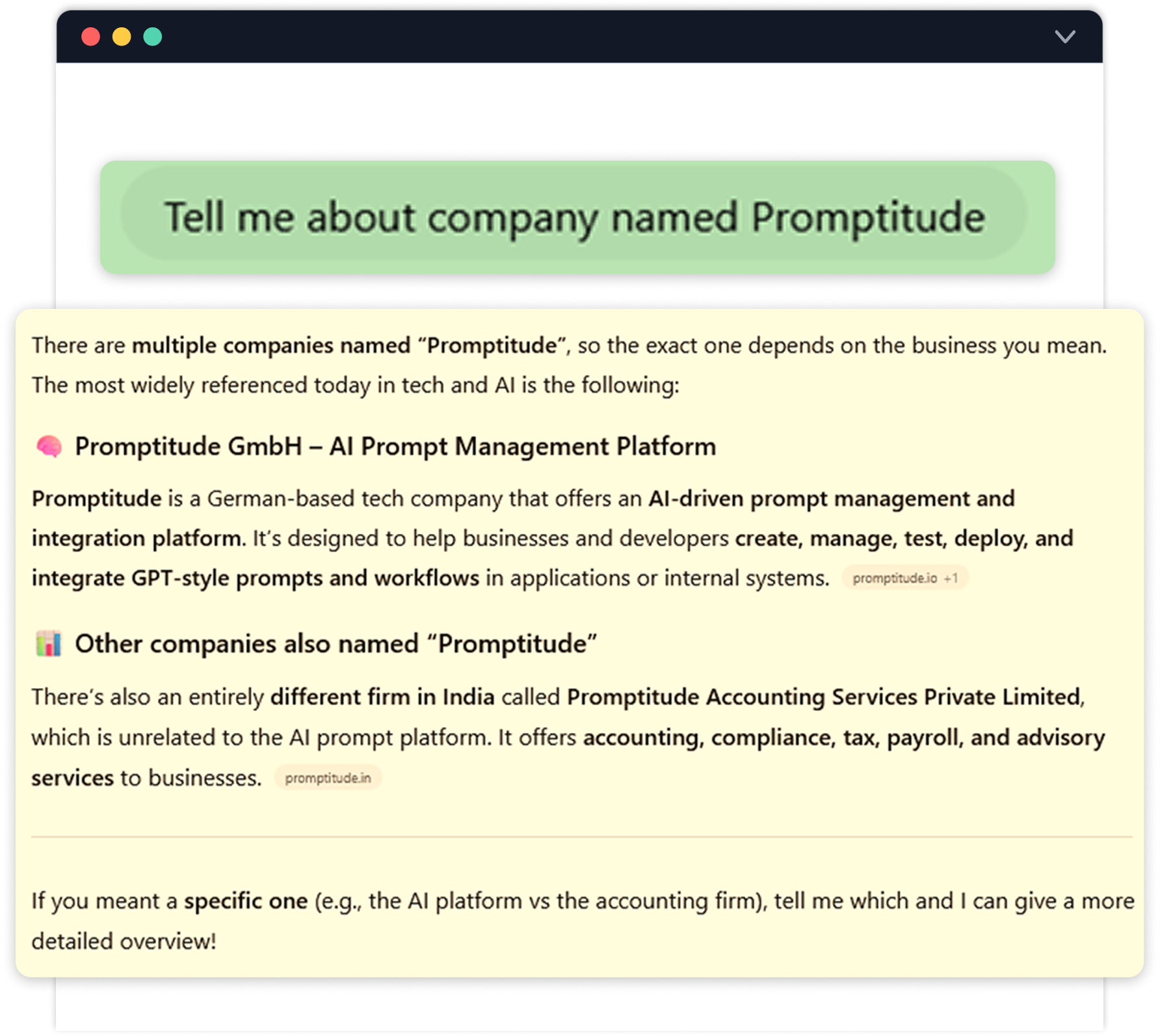
Still not specific enough, but better!
I think I need a bit of help with prompt engineering here. Let me quickly check some guidelines for designing a well-formed prompt at https://www.promptitude.io/post/prompt-engineering-101-10-proven-techniques-to-get-10x-better-ai-results
Got it! Let’s try again. I’ll add more context and specify exactly what I would like to know about the Promptitude company. Oh, and to avoid overly technical explanation, I will ask it to explain it to me like I am a child.
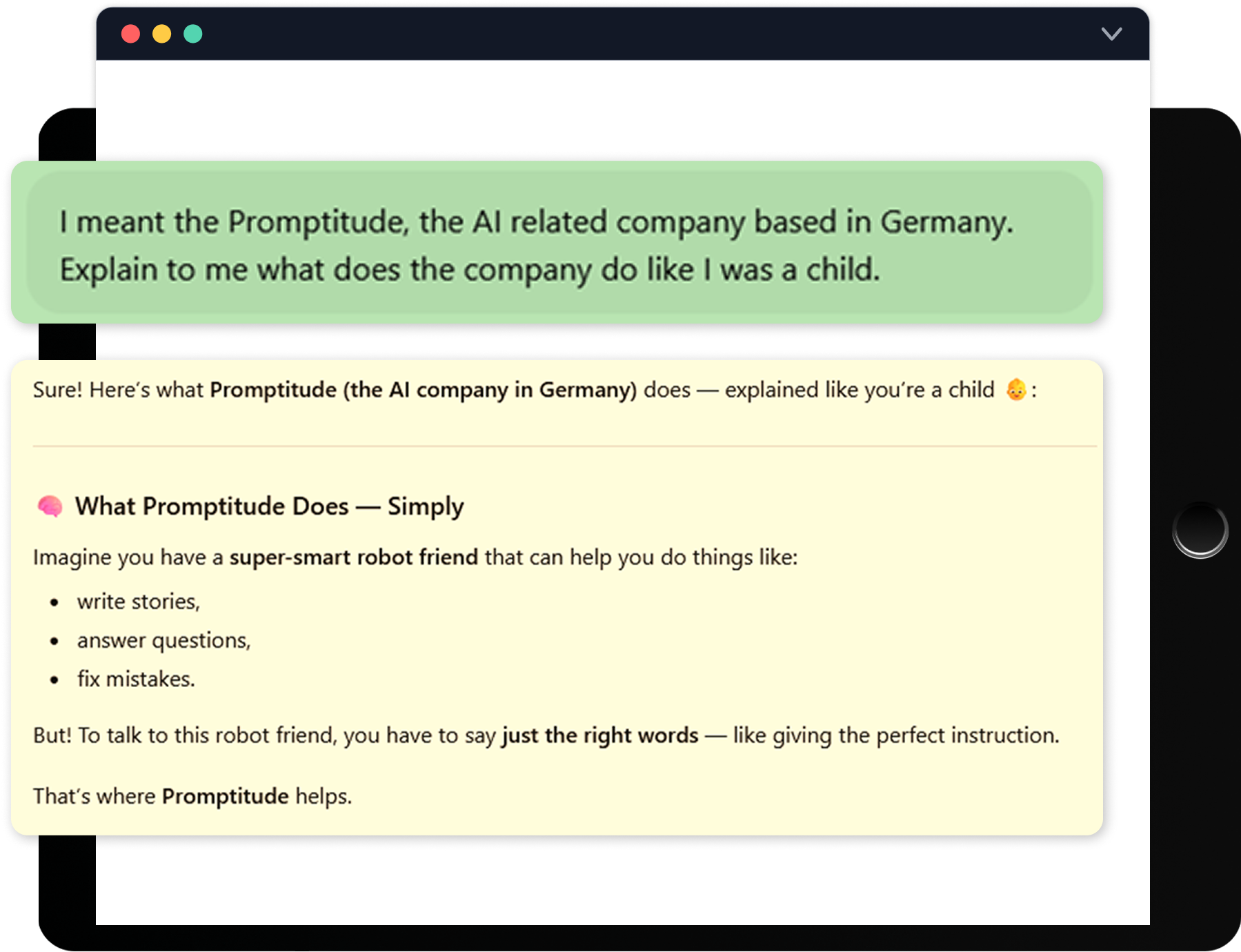
Finally, an answer I am happy about! Also, from now on, I will call AI my “robot friend”.
As we saw from my previous prompts, I don’t always know the right words to talk to my robot friend.
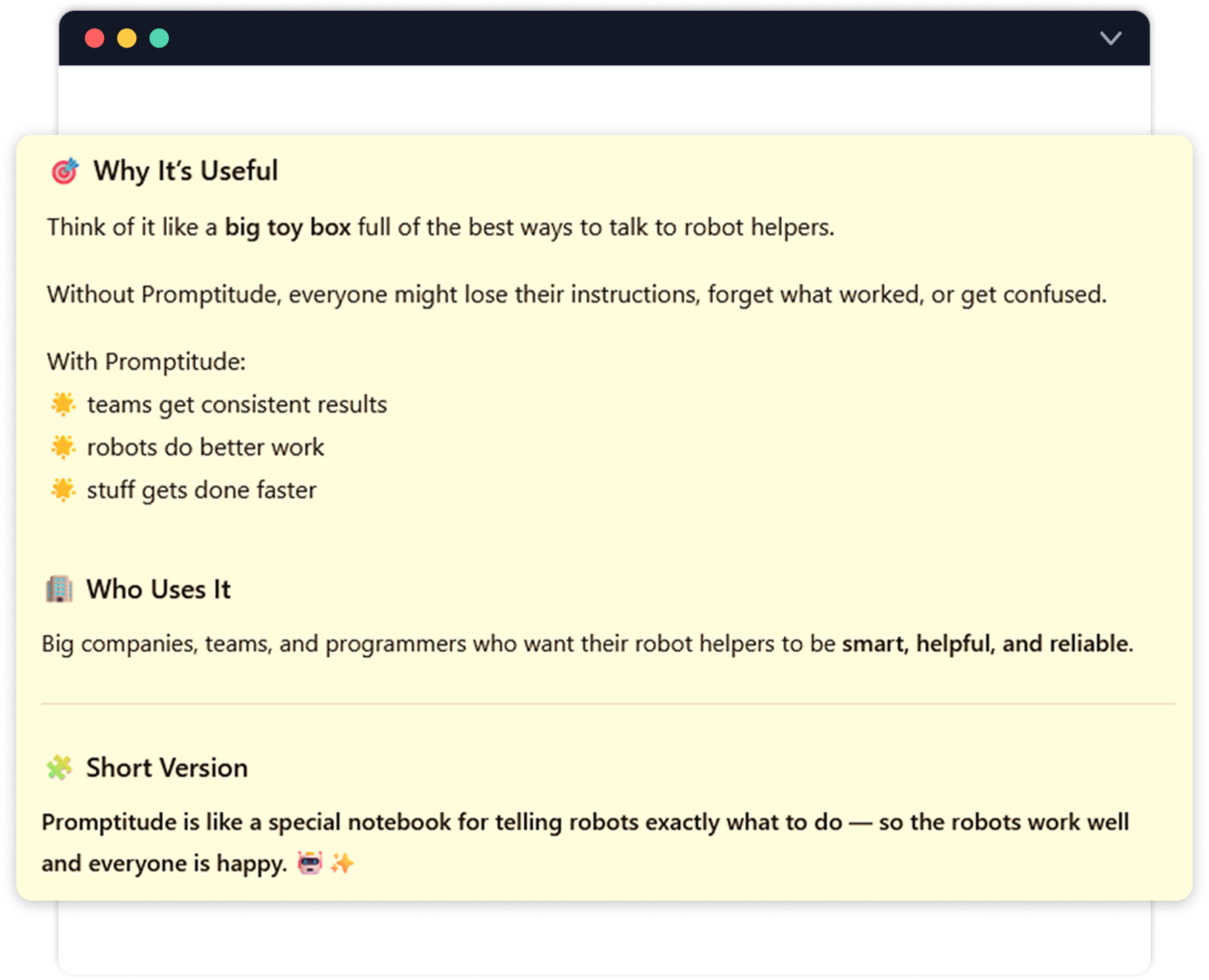
Excellent, my robot friend!
But hey, I have another robot friend. Let’s check how it will deal with the same prompts.
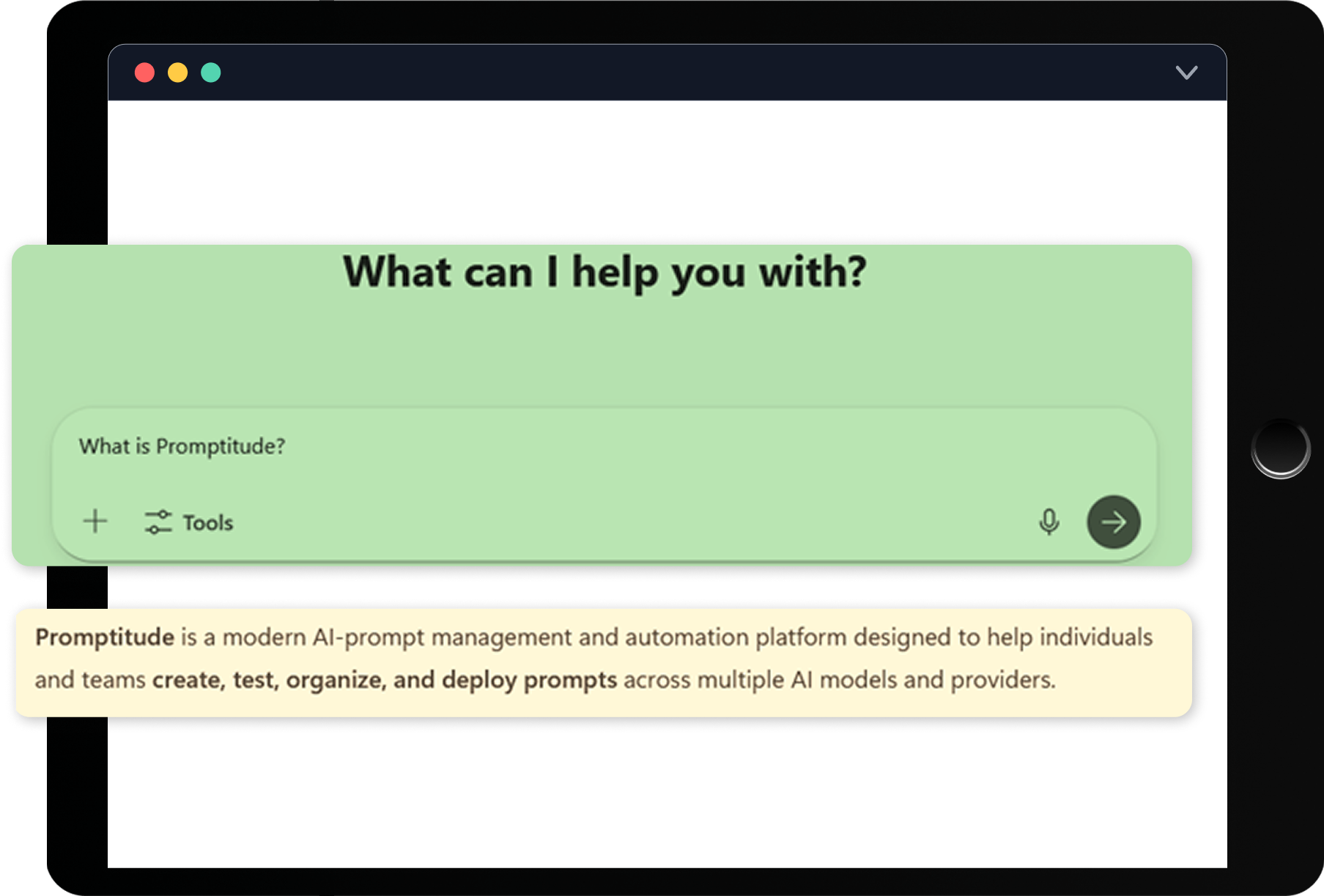
This robot friend knew exactly what I had in mind. Another bell ringing in my head: the importance of the LLM model. Let’s unravel it:
“The term LLM (Large Language Model) describes AI systems trained on vast datasets to comprehend, generate, and interact in natural language.”
But why does AI model selection matter? Let’s do a quick check here >>
I see... so in the same way I would consult an expert on a topic they know the best, I should also consult a specific robot friend that has the best features to support my needs.
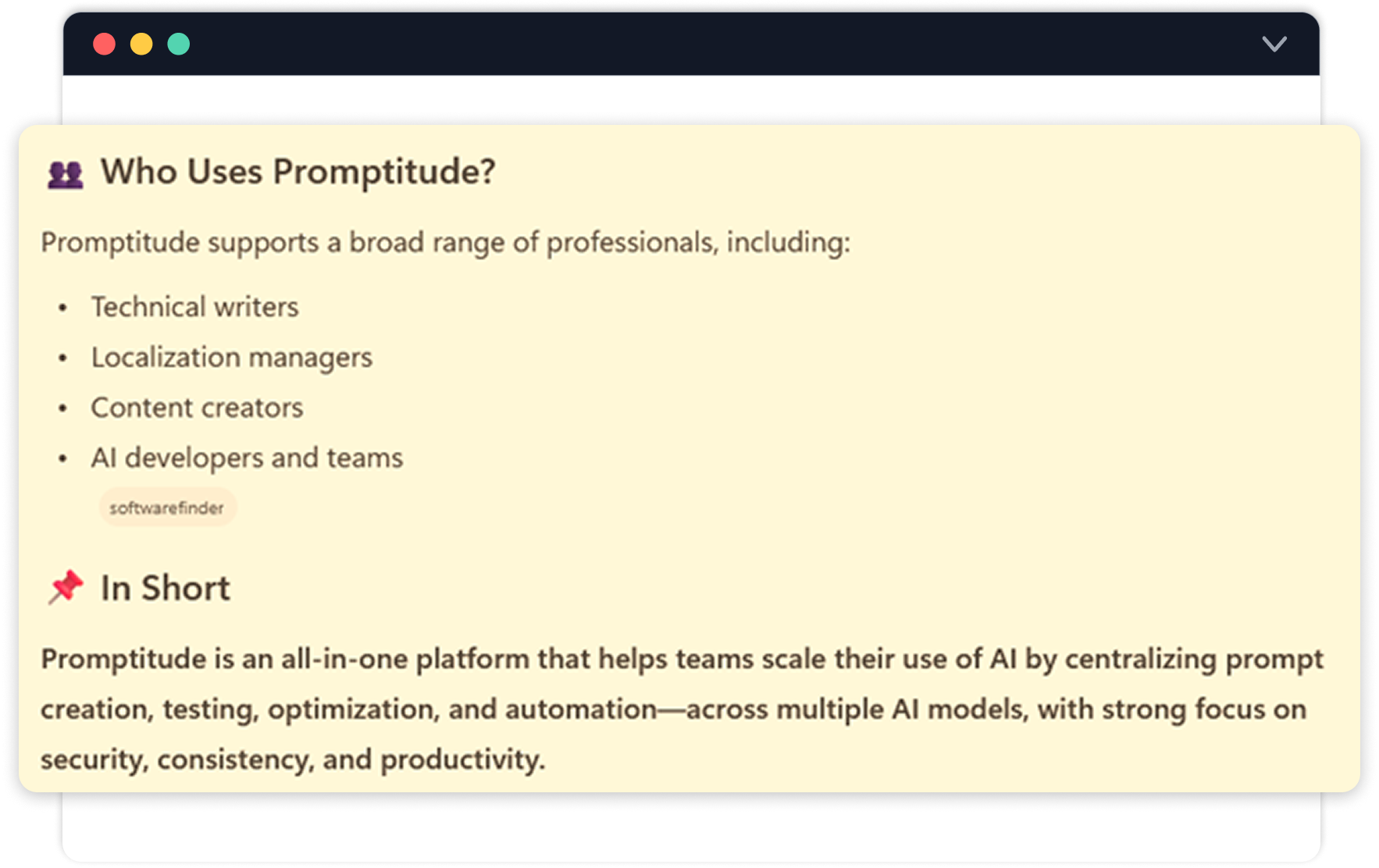
What else does the second robot friend say about Promptitude?
Let’s make this child-friendly.
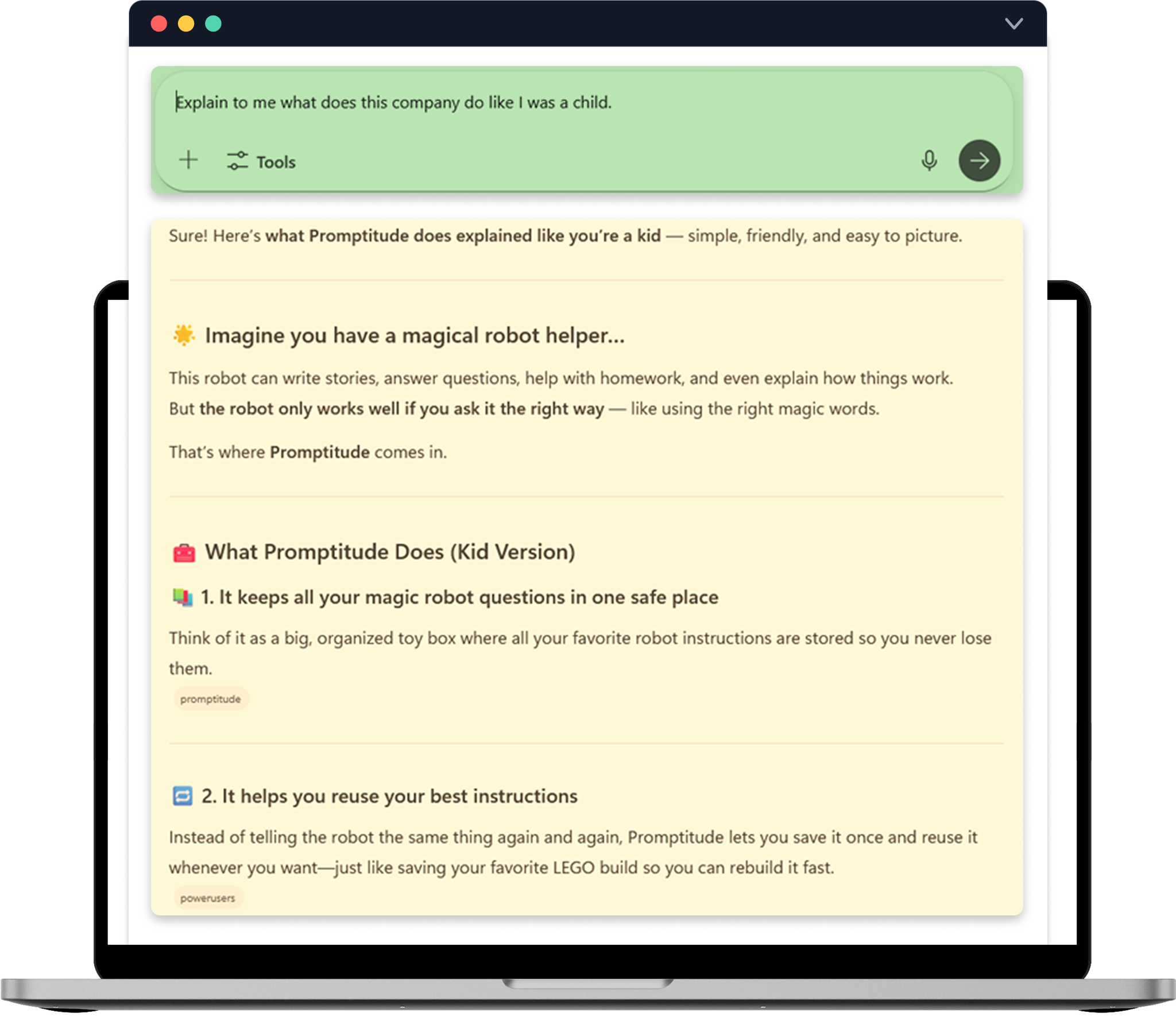
This is crazy, I never told this robot friend that I am an adult LEGO fan. How did it know to use this comparison? Or was it just an educated guess and a nice metaphor, because everyone knows what LEGO is?
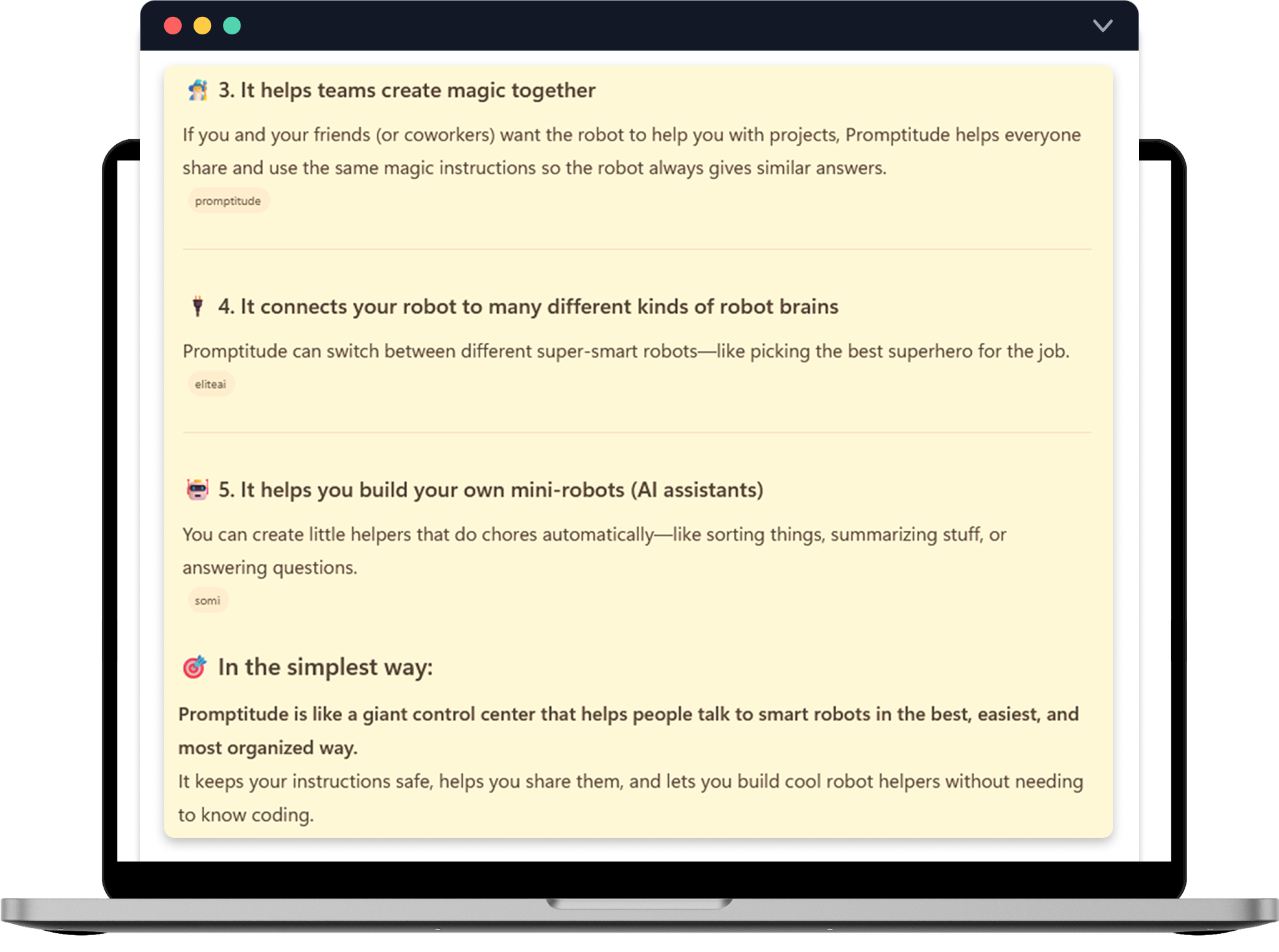
Cool, this robot knows how to approach me. “Without needing to know coding” is exactly the right language to talk to me :D
Let’s have one last bit of fun before I move on to registration.
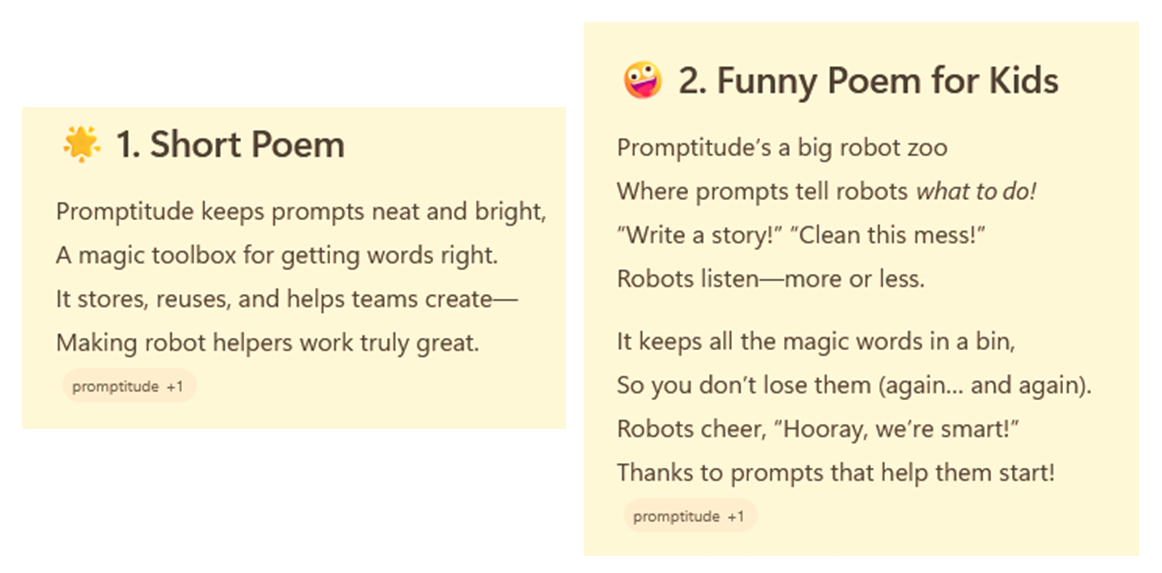
And just like that, I’m stepping into something new. A platform I don’t fully understand yet, guided by a robot friend I’m not sure I trust, hoping it somehow makes my life easier. An excellent recipe for an exciting adventure. Stay tuned for part two to see how this Promptitude journey unfolds.


Easily incorporate advanced generative AI into your team, product, and workflows with Promptitude's plug-and-play solutions. Enhance efficiency and innovation effortlessly.
Sign Up Free & Discover NowErleben Sie die perfekte KI-Lösung für alle Unternehmen. Optimieren Sie Ihre Abläufe mit müheloser Prompt-Verwaltung, -prüfung und -bereitstellung. Optimieren Sie Ihre Prozesse, sparen Sie Zeit und steigern Sie die Effizienz.
Unlock AI Efficiency: 50k Free Tokens



.png)
%20%26%20Content%20Storage.png)